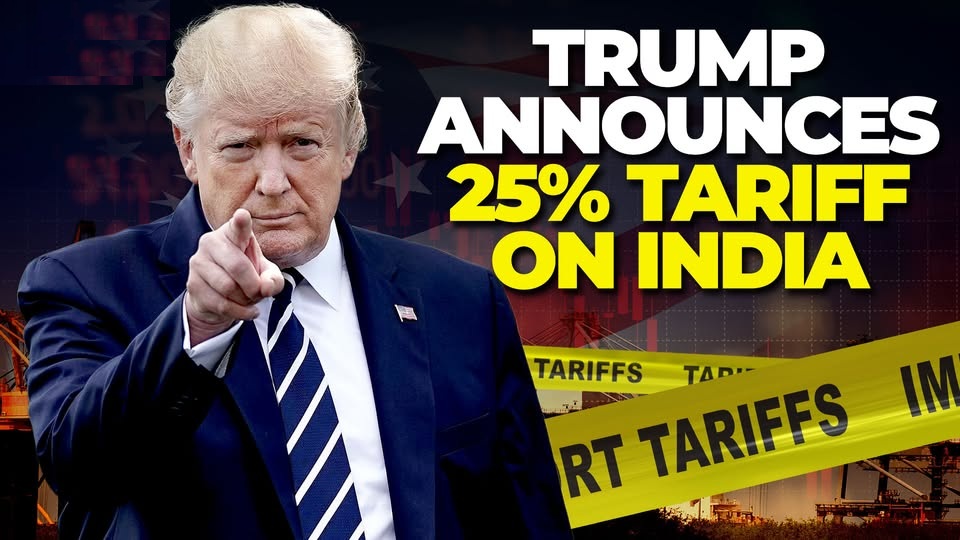
The announcement of a 25% tariff on imports from India by US President Donald Trump, effective August 1, has sent ripples through the Indian business community and the global trade landscape. This tariff marks a significant escalation in the ongoing trade dispute between the two countries and complicates bilateral trade negotiations that were underway. Understanding the depth of this development requires examining why the tariff came into effect, what it means for Indian exporters and industries, the broader geopolitical context, and what the future may hold.
Background: The Growing Trade Dispute
President Trump publicly declared through his social media platform Truth Social that the United States would impose an immediate 25% import duty on a wide range of goods entering the US from India. While earlier expectations suggested a smaller tariff increase, the final rate was the highest band at 25%. This rate means that almost every item exported from India to the US will become 25% more expensive to American consumers after August 1.
Prior to this, India and the US had been trying to finalize a bilateral trade agreement. However, deep differences and India’s refusal to fully open its markets led to increasing frustration in Washington. Trump expressed that India is considered a “friend” but criticized India’s high import tariffs and trade barriers, which he claimed limit US exports to India. This tariff can be considered a leverage move to compel India to align its trade policies with US demands.
Why This Tariff? The Russia Connection and Penalty
One of the less talked about but critical reasons behind the tariff imposition is India’s continuing purchase of crude oil from Russia. At a time when the US and its allies are pushing for sanctions against Russia due to the Ukraine conflict, India remains one of the largest buyers of Russian crude oil.
President Trump explained that the tariff serves as a penalty for India’s close economic ties with Russia. This penalty could be as high as 100% in some cases, particularly if India continues processing Russian crude into refined petroleum products for export to the US. Thus, the 25% tariff is in addition to this penalty, making Indian products even costlier in the American market.
This move signals that the US views India’s Russia trade as undermining Western sanctions and is prepared to use trade restrictions to exert pressure on India to reduce its Russian imports.
Impact on Indian Trade and Industry
The immediate consequence of a 25% tariff will be increased costs for Indian exporters to the US. American buyers will face higher prices, and some may switch to alternate sourcing from countries like Vietnam, Taiwan, or China, despite China’s own trade barriers and tariffs.
Indian exporters in key sectors—textiles, agricultural products, manufacturing goods—may find it harder to compete. The cost increase could reduce India’s export volumes to the US and negatively impact jobs and growth in export-driven industries.
At a macroeconomic level, this will also affect India’s trade surplus with the US. Although the final cost burden is borne by American consumers or importers, the competitiveness of Indian goods will suffer, putting pressure on Indian exporters.
The US Perspective: Seeking Market Access and Fair Trade
The US has long complained about trade imbalances with India, citing India’s higher tariffs and non-tariff barriers that restrict US goods entering the Indian market. India’s tariffs on several US products, including agricultural and dairy items, are relatively high, and India has been reluctant to significantly reduce them.
Trump’s administration is pushing for India to open up its markets fully, to make it easier for US companies to sell goods and services. The 25% tariff is designed as leverage in ongoing negotiations that are set to resume later in August.
It is notable that India is also pressing back, emphasizing its need to protect certain sensitive sectors such as dairy and agriculture, which involve both economic and sentiment issues domestically.
Diplomatic and Economic Stakes
This tariff imposition arrives at a sensitive time when the US is trying to assemble stronger alliances in Asia against geopolitical challenges. India is seen as a crucial strategic partner in the Indo-Pacific region, and bilateral relations are complex, spanning defense cooperation and diplomacy beyond mere trade.
Trump’s aggressive trade stance shows the tension between economic interests and strategic partnerships. India’s adherence to buying Russian crude is a source of friction, seen by the US as a failure to align fully with Western policies.
What Lies Ahead: Negotiations and Possible Outcomes
Despite the harsh step of tariffs, trade experts believe this is largely a tactical posture by the US to gain concessions from India in the upcoming negotiation rounds scheduled for late August. The expectation remains that the 25% tariff may not be permanent and that a “butter trade agreement” or a bilateral trade deal could emerge after further talks.
This ongoing trade dispute highlights the global challenges of balancing geopolitics, economic interests, and national policies. India will need to carefully navigate these waters, balancing market protection with the benefits of access to the large US market.
Concluding Thoughts
The 25% tariff on India by the US is a bold move with multiple layers — economic, political, and strategic. While Indian exporters face immediate challenges, it reflects broader disputes over trade fairness, market access, and geopolitical alignments. As talks continue, businesses and policymakers on both sides must prepare for potential shifts in trade flows and the diplomatic accommodations that will likely follow.