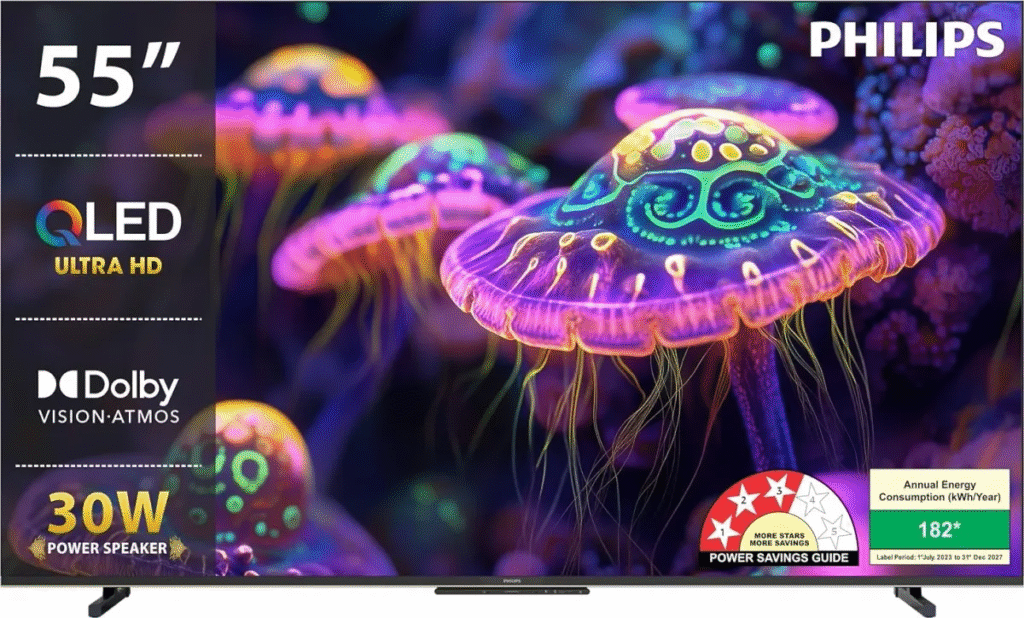
As the television market heats up with fierce competition, the unveiling of Philips’s new 4K QLED TV line for 2025 in India brings an exciting proposition—premium brand quality at prices that challenge budget category competitors. In this comprehensive review, we examine the features, pricing, manufacturing background, user feedback, and market implications of the Philips PQT8100 series launched recently. This new range potentially reshapes expectations around cost and performance in LED TVs.
Introduction: The Price War Between Budget and Premium TV Brands
Traditionally, budget category TV brands have dominated the low-price segment with aggressively attractive price points, leaving premium brands like LG, Samsung, and Sony operating at a higher price tier justified by brand value, build quality, and feature sets. However, a significant market shift is visible in 2025 where premium brands are slashing prices to approach or even undercut budget competitors.
In the lead is Philips with the PQT8100 model series, which offers 4K QLED technology at prices significantly lower than expected for an established premium brand. As of launch, Philips offers several size variants—43”, 50”, 55”, and 65”—with corresponding prices that defy the norm. For instance, the 43-inch variant is available for approximately ₹21,000 after discounts, and the 55-inch model is priced around ₹30,000 post-credit card discounts. The 65-inch model offers even bigger screen real estate at a surprisingly reasonable price — just under ₹40,000 in some promotions. Such aggressive pricing edges close to or below prices of some budget brands.
The Philips PQT8100 Series: Models and Pricing Overview
- 43″ variant: Priced around ₹21,000 after applying a ₹2,000 discount from the listed ₹23,000.
- 50″ variant: Not currently available but will likely fit the aggressive pricing model.
- 55″ variant: Approximately ₹30,000 after a ₹3,000 credit card discount on the ₹32,999 list price.
- 65″ variant: Around ₹40,000 (₹39,999 in some listings).
Comparatively, other budget brands like VW, Xiaomi, Hisense, TCL, and Redmi offer 55” TVs mostly priced between ₹27,000 to ₹37,000. LG’s 55” TVs start higher, typically around ₹41,000, although slightly older models can sometimes be found for less. Philips undercuts even those with advanced QLED technology, which typically costs a premium.
Manufacturing Insights: Who Makes Philips TVs?
Unlike other premium brands that often manufacture TVs in-house or through directly contracted global partners, Philips relies on a third-party Indian company—Radiant Appliances & Electronics Pvt. Ltd.—for manufacturing its PQT8100 models. Radiant also builds TVs for other brands such as Thomson, Blupunk, KODAK, and KA, which are assembled using parts mostly sourced from China and put together in India.
This manufacturing strategy keeps costs low, allowing Philips to price their TVs aggressively despite the premium branding and decent specs. The profit margins are still present but slim, given the downward pressure on pricing to compete with budget brands.
Technical Specifications and Features
The Philips PQT8100 is positioned as a high-spec QLED TV with the following technical highlights:
- Resolution: 4K Ultra HD (3840×2160 pixels)
- Display Technology: QLED (Quantum Dot LED) for wider color gamut and better brightness
- Refresh Rate: 120Hz, providing smoother motion for gaming and fast-moving content
- HDR Support: HDR10+ and Dolby Vision, enhancing dynamic range and color accuracy
- MEMC (Motion Estimation, Motion Compensation): For clearer motion in videos and sports
- Operating System: Google TV, offering a rich content ecosystem and smart features
- Storage & Memory: 2GB RAM with 32GB internal storage, sufficient for apps and smooth operation
- Sound: Dolby Atmos support for immersive audio experience
- Color Gamut: 93% DCI-P3, delivering vivid and accurate colors ideal for movie watching and gaming.
These features typically align with premium segment TVs, and combined with an affordable upfront price, they form a compelling value proposition.
Display and Visual Quality Considerations
As a QLED panel TV, the PQT8100 promises better brightness and color saturation compared to standard LED TVs. However, initial user feedback and early reviews show mixed results. Some users report overly saturated colors and software-related sluggishness or lag, impacting the viewing experience.
Reports of occasional screen “hangs” during video playback and less-than-fluid software response have emerged, indicating software optimization might be a point for future improvement. The panel, while supporting HDR and Dolby Vision, may face issues typical of budget-assembled models, such as uneven backlighting or color inconsistencies.
That said, these concerns need to be weighed against the price. For a 4K QLED with Dolby Vision at roughly ₹30,000-₹40,000, minor compromises might be acceptable to many consumers seeking big-screen entertainment without straining their budget.
User Experience and Software Performance
The TV runs on Google TV OS which is widely appreciated for its user-friendly interface and access to a large app ecosystem. Despite this, there are reports of occasional software lag and slow response times which may detract from overall usability.
The presence of paid or incentivized reviews is also a consideration, suggesting cautious optimism until more organic, long-term user reviews become available. Observers recommend that prospective buyers wait for extensive real-world feedback before full commitment.
Market Impact: A Game Changer for Budget Category TVs?
Given the Philips PQT8100’s blend of premium features at budget-level pricing, its launch could disrupt existing market dynamics. Budget brands might need to lower prices further and possibly cut costs on components, risking declining build and display quality.
Philips offering a recognizable premium brand experience at these prices also appeals to consumers concerned with reputation and perceived quality—many buyers choose premium brands to feel assured of longevity and brand support.
If Philips can maintain reasonable build quality alongside their aggressive price points, it will likely attract substantial market attention, nudging budget brands into a tighter competitive position.
Caveats and Recommendations for Buyers
- Wait for More Reviews: The TVs are newly launched, and long-term performance data is sparse.
- Watch for Software Updates: Potential early software glitches may get fixed with updates.
- Check Warranty and Service: Consider availability of after-sales support in your region.
- Expect Some Compromises: Low prices may mean compromises on display uniformity and software polish.
- Consider Use Case: Ideal for budget-conscious buyers wanting premium brand name and features without heavy investment.
Conclusion
Philips’s 2025 4K QLED TV series, particularly the PQT8100, represents a significant development in India’s television market. Offering premium specifications including QLED panels, 4K resolution, Dolby Vision, and Google TV OS at surprisingly affordable prices is likely to attract consumers looking for the best value for money.
While some initial user feedback signals room for improvement, the overall package challenges the traditional divide between budget and premium categories. Philips’s strategic partnership with Radiant Appliances appears to enable these competitive prices possibly at leaner margins.
As this series matures and more user experiences accumulate, it will be interesting to see how it influences competing brands and consumer buying patterns in the rapidly evolving Indian TV market.