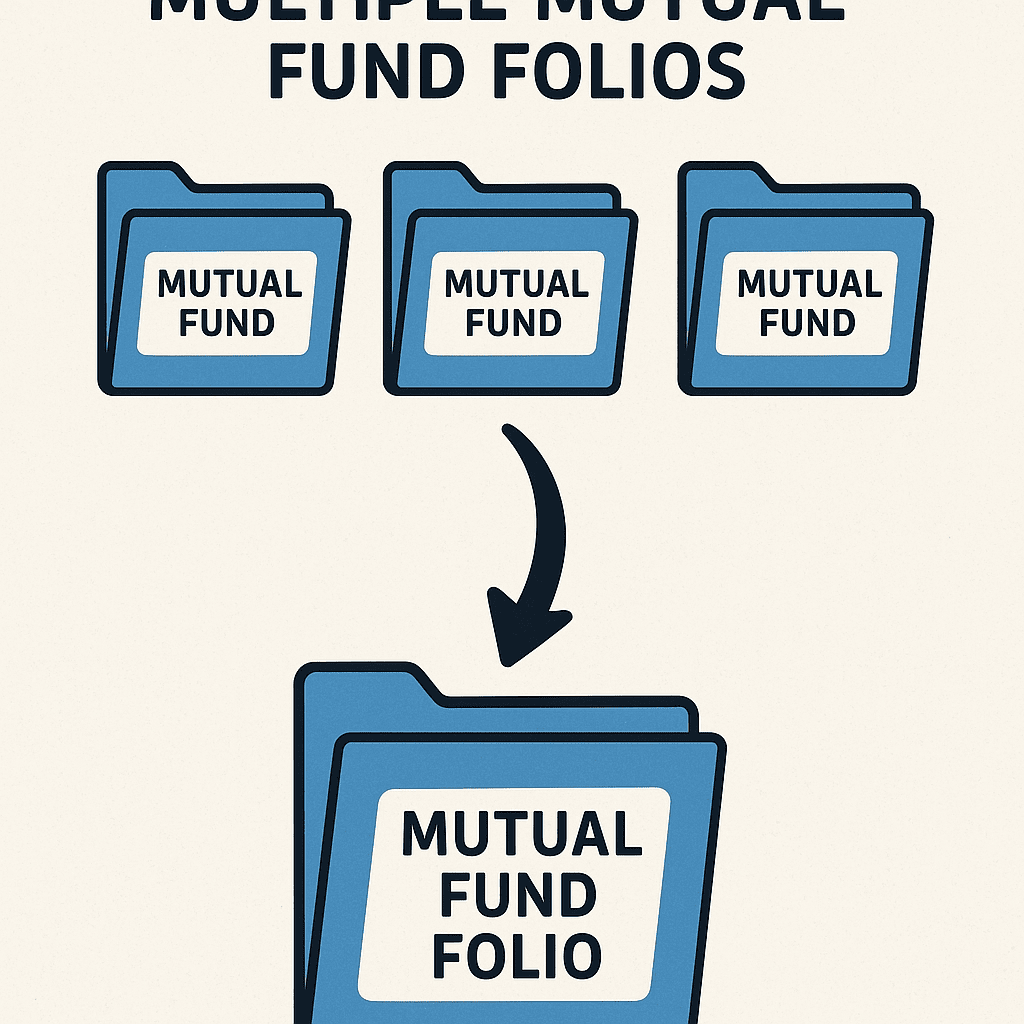
When you invest in mutual funds, each investment or transaction is tracked by a unique folio number issued by the Asset Management Company (AMC). Think of a folio number as analogous to a bank account number but for your mutual fund investments. It uniquely identifies your holding and tracks all related transactions within that mutual fund scheme.
However, many investors inadvertently end up with several folio numbers within the same mutual fund company and even for the same scheme. This usually happens when:
- You invest through different platforms or distributors without linking or mentioning an existing folio number.
- When reinvesting, you do not specify your current folio number.
- If multiple investment modes or SIPs are started on different folios.
This leads to the problem of multiple folios for what ideally should be consolidated under one folio.
Why Having Multiple Folios Is a Problem
Multiple folios create several issues for investors:
- Difficult to Track: With investments scattered across different folios, it becomes challenging to get a holistic view of your total holdings and assess the overall portfolio performance.
- Cluttered Portfolio Management: Managing numerous folios increases complexity. Analyzing returns or deciding on switching or redeeming becomes cumbersome.
- Increased Paperwork: You receive multiple statements, tax documents, and transaction summaries for each folio, creating unnecessary paperwork and increasing the likelihood of errors.
- Redemption and Switching Complexity: If you want to redeem or switch funds, you must do it for each folio individually, increasing the effort and chances of missed transactions.
- Potential KYC Mismatches: Credentials like PAN, address, or nominee details might slightly differ across folios, causing verification issues later.
What Exactly is a Folio?
Before diving into the solution, it’s essential to understand what a folio is in mutual funds:
- A folio number is a unique ID given by an AMC to an investor’s set of investments.
- It links all transactions, units held, dividend details, and other relevant information of the investor in that AMC.
- Just like a bank account manages deposits and withdrawals, a folio number manages your mutual fund transactions.
- Typically, one folio number corresponds to one set of holdings for an investor within a particular AMC.
Can Folios Be Merged?
Yes, folios within the same mutual fund company can be merged or consolidated to simplify investment tracking and management.
- You designate one folio as your target folio (the main folio where all investments will be consolidated).
- The other folios become source folios (these will be merged into the target folio).
- Post-merger, all future transactions will be tracked under the target folio.
- This consolidation makes your portfolio neat and easier to handle.
Conditions for Merger of Folios
To merge folios, certain strict conditions must be met because mutual funds maintain several checks to ensure data integrity and compliance:
- Same AMC/Fund House: Folios from different AMCs cannot be merged. The folios must belong to the same mutual fund company.
- Matching Holder Details:
- The sequence and order of all holders’ names on the folio must be the same.
- PAN numbers of all holders must be identical.
- Tax status of the investor must be the same on all folios.
- The holding mode (single, joint, or guardian and survivor) must be identical.
- Non-Demat Folios: Folios should be non-demat and in Statement of Account (SOA) mode, not dematerialized.
- No Active Transactions in Source Folios:
- SIPs, STPs, SWPs active in source folios prevent them from being merged.
- However, the target folio can continue to have such active transactions.
- Bank, Contact, and Nominee Details:
- These can differ in source folios vs. target folio.
- Post-merger, the details of the target folio will prevail as final.
- Signatures:
- All folios being merged require the signatures of all holders.
- This is a crucial compliance step.
What Happens if a Folio Does Not Meet Merge Criteria?
- Those source folios not matching the required conditions remain separate.
- The investor is informed about which folios could not be merged and why.
- Only eligible folios that meet all conditions are consolidated.
After Merging
- After the merger is complete, you will have only one active folio number per AMC for your investments.
- All future transactions, purchases, SIPs, or redemptions must be done through this single folio.
- You cannot reverse or split merged folios later.
- Confirmation of the successful merger is sent to your registered contact details.
How Long Does It Take to Merge Folios?
- The process usually takes about 10 working days (T+10) from the date of request submission.
- During this time, AMC processes the request, verifies data, and completes the consolidation.
How to Merge Folios – Step-by-Step Process
We suggest two main methods:
1. Using MF Central (Digital Platform)
MF Central is a popular platform that enables investors to manage multiple mutual fund folios across AMCs.
- Log in to your account on MF Central.
- Go to Service Requests.
- Select Consolidation of Folios.
- Choose the mutual fund house (AMC) from which you have multiple folios.
- You will see your folios listed. Select one as the Target Folio.
- Select other folios as Source Folios to be merged into the target.
- Confirm and submit your request.
- Enter the OTP sent to your registered mobile number or email.
- Post validation, the consolidation request is processed successfully.
This automated online process reduces paperwork and speeds up the process.
2. Manual Process via Fund House Website or Registrar (KARMS/CAMS)
If the online option is unavailable or you prefer offline:
- Download the folio consolidation form from the AMC’s website or registrar’s portal.
- Fill in details of the folios involved (target and source).
- Attach requirements like PAN, KYC proofs if needed.
- Print and sign the form by all folio holders.
- Submit the form with supporting documents at the AMC’s registered office or official registrar point (CAMS/KARMS).
- Await confirmation post-process completion.
Additional Important Points
- You can consolidate up to 10 source folios into a single target folio in one go.
- If your target folio is a single-holder folio and has no nominee details, nominee registration becomes mandatory during consolidation.
- Only folios of the same AMC and same scheme (or across schemes of the same AMC) can be merged, not across different AMCs.
- Consolidating your folios leads to clearer portfolio management, fewer statements, and smoother redemption and switching experiences.
- Always consult your mutual fund distributor or use investor services portals for detailed guidance.
Why Should You Consolidate Folios
- Simplified tracking – easy to view your total investments in one place.
- Accurate and consolidated portfolio reports.
- Reduced paperwork and hassle during tax filing.
- Easier fund switching or redemption.
- Minimized risk of KYC mismatches or dividend payment errors.
Conclusion
Merging multiple folios in the same mutual fund company is an advisable step for all investors who find their investment portfolio cluttered and difficult to monitor. With proper matching criteria and a straightforward process through digital or offline modes, this task can be done in about 10 working days. Post-merger, investors enjoy the benefits of enhanced portfolio clarity, simplified paperwork, and hassle-free transactions.