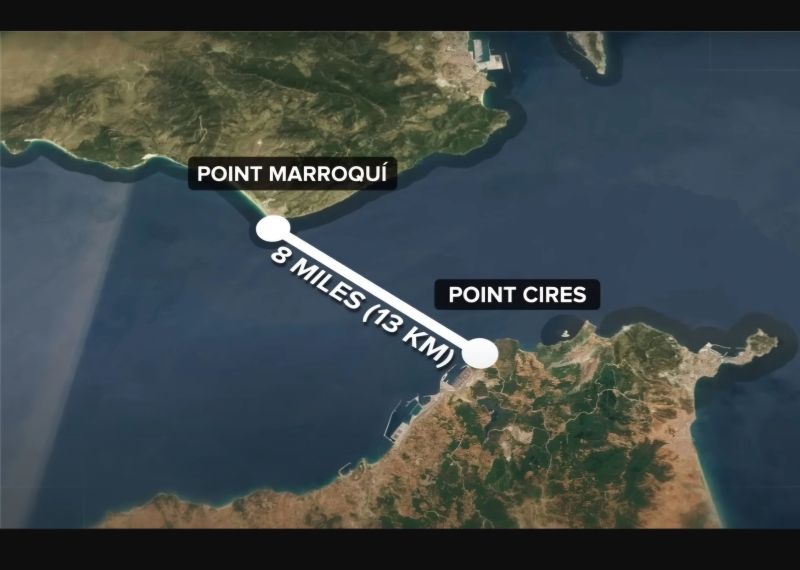
The idea of physically linking two continents, Europe and Africa, just 14 kilometers apart across the Strait of Gibraltar, sparks a fascinating question: Why has no bridge or tunnel been built despite the seemingly short distance and enormous strategic potential?
The Basic Geography and Strategic Importance
The Strait of Gibraltar is a narrow waterway that separates Spain in Europe from Morocco in Africa. The gap is roughly 14 kilometers wide — less than the distance between Mumbai and Navi Mumbai, a trip one can make within 30 minutes by road. Imagine if a bridge or tunnel crossed that stretch: it would connect two wholly different continents in under half an hour by land.
This connection would have monumental global impacts. Annually, nearly 100,000 ships and 18,000 oil tankers traverse this strait, which funnels approximately:
- 33% of the world’s oil and gas supply,
- 50% of global trade, and
- 80% of the European Union’s merchandise, including electronics, raw materials, and automobiles.
Many countries in Europe, Africa, and Asia heavily depend on this narrow maritime corridor for commerce and energy.
Despite this colossal strategic importance, no bridge or tunnel exists here, and no country has succeeded even after more than a century of proposals and studies.
Historical Ambitions and Visionary Plans
In the early 20th century, German architect Herman Sorgel proposed a daring plan called Project Atlantropa, which involved building a massive hydroelectric dam across the Strait of Gibraltar. The concept was to drain the Mediterranean Sea by about 200 meters, reclaim land to physically join Africa and Europe, and generate enormous power — effectively creating a new continent, Atlantropa.
Sorgel’s vision was bold but daunting. It required not just a single dam but several others around the Mediterranean, including dams at the Turkey-Greece border (Dardanelles) and Sicily-Tunisia, to manage water levels. The plan also included lock chambers to handle the difference in sea levels and allow ships passage, similar to the Panama Canal system.
However, the environmental impact, enormous financial cost, and technological challenges were enormous for the time (the 1920s). Additionally, the political backing was insufficient despite lobbying efforts. After Sorgel’s death in 1952, the project quietly ended.
Engineering Challenges: The Depths and Currents of the Strait
While building bridges or tunnels elsewhere over longer distances has been achieved, such as the 55-kilometer Channel Tunnel between the UK and France or the massive Hong Kong–Zhuhai–Macau Bridge, the Strait of Gibraltar poses unique complications:
- Extreme Depth: The narrowest “Canyon Route” on the Strait is about 14 km long, but its depth reaches about 800 meters. By comparison, the Channel Tunnel’s deepest point is only 180 meters. Constructing bridge pillars or tunnels at this scale is unprecedented and hugely expensive.
- Geological Weakness: The seabed largely consists of unstable materials like breccia and clay with high porosity and weak structural integrity. This makes it difficult to anchor bridge pylons or ensure stable tunnel construction without risking collapse.
- Hard Rock Layers: Beneath the soft sediments lies a hard rock layer, complicating digging or drilling.
- Seismic Activity: The Strait lies directly on a fault line between the African and Eurasian tectonic plates, an active seismic zone. It has witnessed devastating earthquakes like the 1755 Lisbon earthquake. Constructing any fixed structure in such a shock-prone zone is an immense engineering gamble.
- Strong Ocean Currents and Environmental Considerations: The Strait contains fast currents — up to 11 km/h at the surface — created by interaction between warm Mediterranean water and cold Atlantic water. This creates turbulent, vortex-prone waters, making stable surveying and construction difficult. The environmental sensitivity of Mediterranean and Atlantic ecosystems complicates interventions even further.
Economic and Political Hurdles
The huge cost of constructing such megastructures — estimated in billions of dollars — deters investment. Beyond engineering, strategic and diplomatic barriers are just as formidable:
- Spain and Morocco have a complicated relationship, particularly over territorial disputes concerning enclaves like Ceuta and Melilla. Political disagreements have repeatedly delayed cooperation on the project.
- Important diplomatic incidents, such as Spain’s visits to disputed territories or granting medical treatment to Moroccan rebel leaders, have exacerbated tensions, pausing progress multiple times.
- For decades, joint efforts have been made by Spanish and Moroccan public companies (SEXE and SNED) conducting surveys, which have been hindered by technical challenges and political stalemates.
- The Strait of Gibraltar is one of the busiest shipping lanes in the world, carrying not only commercial traffic but also military vessels. Any construction must allow a minimum 70 meters clearance above sea to maintain uninterrupted shipping, adding complexity.
Engineering Proposals and Current Status
One notable modern proposal by American engineer Eugene Zui envisioned a floating bridge spanning the Strait, avoiding the need for deep pylons by using buoyant, flexible modular floating platforms anchored with cables. This design anticipated a floating city with roads, railways, renewable energy farms, and public amenities.
Despite the futuristic vision, funding was a major obstacle — estimated roughly around $10 billion — and technical challenges in terms of anchoring safely in turbulent, deep waters remained.
Later studies identified two main feasible routes:
| Route Name | Distance | Depth | Geological Features | Status |
| Canyon Route | 14 km | 800 meters | Deep & weak seabed | Too deep for bridge/tunnel |
| Threshold Route | 28 km | 300 meters | Shallower, more stable | Preferred for tunnel, less challenging |
Current consensus is a multichannel tunnel system of about 28 km length along the Threshold Route, which is shallower and geologically less complex than the Canyon Route. The plan involves three tunnels — two for rail tracks and one service tunnel — which would reduce travel time drastically and facilitate rail-based freight and passenger movement.
Contracts were awarded in the 2000s to engineering firms capable of handling complex tunneling, but the onset of political conflicts since 2008 paused the initiative indefinitely.
The Way Forward: Building Bridges or Building Trust?
The need to link Europe and Africa via land is widely acknowledged by global powers due to its strategic importance. Pressure from international stakeholders, including the US, UK, China, India, and the EU, continues to urge both Spain and Morocco to resolve conflicts and revive the project.
However, experts agree that the first “bridge” to be built may well be one of political trust, cooperation, and mutual benefit before an actual physical bridge or tunnel can be completed.