Introduction
On July 29–30, 2025, a titanic 8.8 magnitude earthquake struck off Russia’s Kamchatka Peninsula, instantly ranking among the most powerful seismic events ever recorded. Its shockwaves reverberated not only through Russia’s far east but across the entire Pacific Rim, leaving Japan, China, Alaska, and even coastlines as distant as Hawaii and the U.S. West Coast scrambling to respond to tsunami threats and the specter of disaster.
This deep-dive explores the origins of the quake, its science, the immediate and ongoing fallouts in these nations, and the lessons the world must heed in the wake of one of the 21st century’s most consequential seismic crises.
Anatomy of the Russia Earthquake
Epicenter and Magnitude
The earthquake struck at a depth of approximately 12–20km, about 120km southeast of Petropavlovsk-Kamchatsky, the largest city on the Kamchatka Peninsula. The USGS, Russian authorities, and global seismological centers registered it at magnitude 8.8, with initial readings as high as 8.7 to 8.8 on the Richter scale.
Tectonic Context
This region is part of the Pacific “Ring of Fire,” a volatile arc famed for its intense seismic and volcanic activity due to the convergence of several major tectonic plates. The quake’s energy release placed it among the top six most powerful quakes in history.
Immediate Impact in Russia
Kamchatka Peninsula
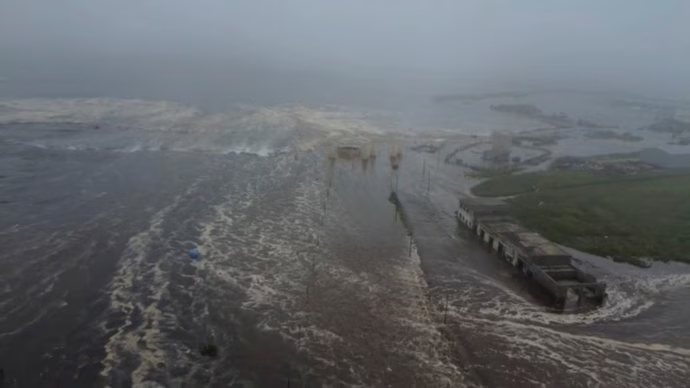
- Severe Shaking and Tsunamis: Houses rocked violently, cabinets toppled, mirrors shattered, and buildings swayed as powerful aftershocks rippled through Kamchatka. Tremors damaged infrastructure, especially in Petropavlovsk-Kamchatsky and smaller towns. One of the first tsunami waves, rising 3–4 meters (10–13 feet), inundated coastal areas, especially Severo-Kurilsk and several fishing settlements.
- Evacuations: Authorities launched urgent coastal evacuations, with citizens fleeing to higher ground, some barefoot or without warm clothing in their rush. The Sakhalin Governor issued orders vacating Severo-Kurilsk—the primary Kuril Islands settlement—until the tsunami threat passed.
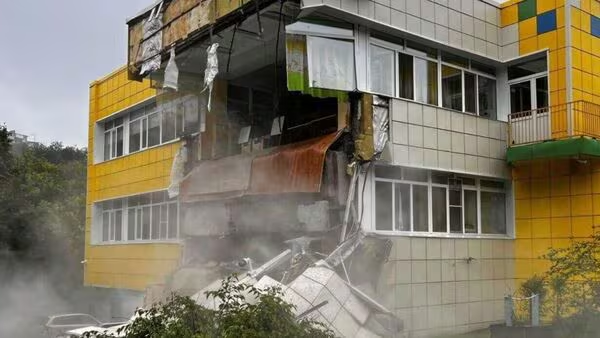
- Infrastructure Hit: At least one kindergarten and several homes were damaged. Airports reported minor injuries. Seafood and fish-processing plants suffered extensive flooding, and local businesses saw their goods scattered by violent shaking and water inundation.
Japan: On the Edge of the Wave
Tsunami Alerts and Evacuations
- Immediate Reaction: The Japan Meteorological Agency issued tsunami advisories, rapidly upgrading to warnings as data confirmed tsunami generation. Waves between 1–3 meters (3–10 feet) were expected along the Pacific coastlines of Hokkaido, Honshu, and Kyushu, with the first impacts anticipated within 30–60 minutes.
- Real Impact: In Oarai, Ibaraki Prefecture, and northern Japan, the tsunami was observed breaching sea defenses and surging inland, prompting beach and port closures. Elsewhere, the waves were lower than expected—about 30cm to 1m—yet caused persistent flooding in low-lying areas. Local TV broadcast scenes of water sweeping through seaside towns, inundating roads and sweeping away small boats.
- Public Response: Sirens sounded, and authorities ordered immediate evacuations from all vulnerable coastal regions. NHK and local outlets urged residents to head for higher ground or designated evacuation centers.
- Disruption: Rail lines and sea traffic were suspended across affected areas, including the ports of Hokkaido and eastern Honshu.
Longer-Term Effects
While early reports suggested Japan avoided a repeat of the 2011 tsunami catastrophe, harbors, wharves, and some residential districts experienced significant water intrusion, property damage, and business interruptions. Some schools and factories suspended operations as a precaution.
China: Tsunami Warnings and Coastal Risk
Official Response
- Tsunami Warning Issued: China’s Ministry of Natural Resources’ Tsunami Advisory Center confirmed that tsunami waves between 30cm and 1m were expected along the eastern seaboard, notably impacting parts of Shandong, Zhejiang, and Fujian provinces.
- Local Alerts: Municipal authorities across the eastern coast activated emergency plans, ordering vessels back to port, closing beaches, and urging the public to avoid coastal areas.
Actual Impact
- Damage Reports: Although no catastrophic swell struck mainland China, minor flooding of low-lying harbors and marinas occurred, resulting in some property loss, damage to docked vessels, and risk to aquaculture operators. In some cases, waves overtopped sea walls—especially in less fortified areas. There were no immediate reports of fatalities, but economic impacts were felt in coastal industries.
Alaska: Evacuations and Coastal Defenses Tested
Tsunami Alerts Across the Pacific North
- Wide-Scale Warning: The U.S. Tsunami Warning Center issued warnings stretching from the western Aleutian Islands to the Pribilof Islands and Chignik Bay, with advisories extending to the full Alaska coastline and the broader U.S. West Coast.
- Local Effects: Waves of approximately 1–1.4 feet (30–40cm) were recorded in Atka and Adak. In cities like Unalaska and Saint Paul, citizens were told to evacuate to higher ground. Sirens sounded in at-risk districts, and many communities swiftly activated emergency plans.
Response and Resilience
- Evacuations: Residents in evacuation zones followed established routes inland or to elevated refuges.
- Wave Impacts: While the observed tsunami waves were modest, Alaska’s ports faced hazardous surges that caused strong currents and minor flooding. Harbormasters reported light damage to moorings and floating docks, but no significant structural destruction.
The Science: How a Mag 8.8 Earthquake Unleashes a Tsunami
Subduction Zones and Tsunami Generation
This quake occurred in a subduction zone, where the Pacific Plate dives beneath the Okhotsk Plate. Such vertical displacement of the seafloor during the rupture—by many meters over a vast distance—expelled massive volumes of water, triggering multiple tsunami wavefronts.
- Multiple Waves: Tsunamis often arrive as a series; the first may be smaller, lulling observers into a false sense of security, before subsequent, larger waves appear hours later.
- Global Reach: Energy from a quake of this size propagates across the entire Pacific Basin, reaching distant shores in 8–20 hours.
Global and Regional Implications
Early Warning Systems
- Pacific Tsunami Alerts: The seismic event activated warning systems from Eurasia to the Americas. Hawaii, Guam, the Marianas, and even Peru, Ecuador, and New Zealand received tsunami alerts. Authorities promptly shut beaches and urged widespread vigilance.
- Effectiveness: Although critical infrastructure (like Japan’s disaster communications and Alaska’s siren system) was tested, the mostly swift response and contained damage underscored the importance of international data sharing and real-time monitoring.
Economic & Social Costs
- Disruption: Trade ports, fisheries, coastal resorts, and local economies spanning Russia, Japan, China, and Alaska faced closures, shipping delays, and interruptions to supply chains.
- Resilience: Community preparedness—built in the aftermath of previous disasters—proved essential in preventing large-scale fatalities and minimizing property losses.
Lessons and The Road Ahead
Preparedness Saves Lives
From Russia’s Far East to Alaska, experience with past disasters led to better public awareness, planning, and faster emergency response. Still, these events highlight ongoing vulnerabilities, especially in older or inadequately fortified coastal communities and industries.
Seismic and Tsunami Research
- The earthquake will likely fuel renewed scientific interest in the seismicity of the Kamchatka subduction zones and spur investment in monitoring technology.
- Global cooperation, real-time seismic analysis, and improved coastal defenses remain vital to withstanding future megaquakes.
Climate and Infrastructure Challenges
As sea levels rise and coastal populations grow, the dangers associated with tsunamis become more acute. Reinforcing seawalls, resilient urban planning, and continued trans-Pacific information sharing are all critical survival tools for the modern age.
Conclusion
The 2025 Russia earthquake and ensuing trans-Pacific tsunami serve as a stark reminder: Nature’s destructive power can radiate across oceans, sending literal and figurative shockwaves to the world’s most technologically advanced nations. While quick action and modern systems prevented catastrophe on the scale of previous disasters, the trembling earth has spoken—vigilance, science, and cooperation are our best shields against the next seismic challenge.