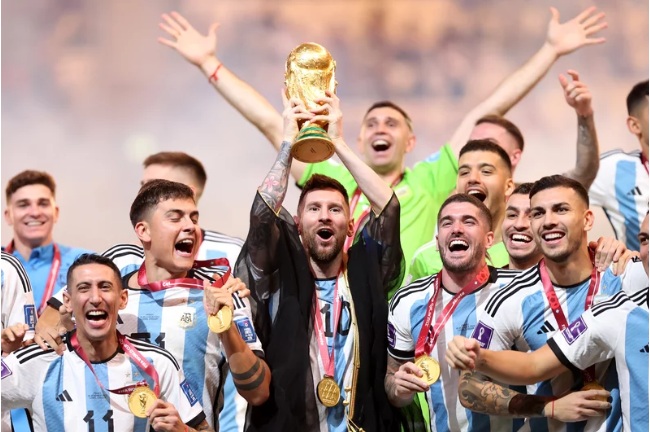
The Making of a Legend
In the pulsating heart of Buenos Aires, under the gaze of over 80,000 spectators and the awestruck millions at home, history unfolded. The world watched as Lionel Messi, the boy from Rosario, finally fulfilled his dream: to lift the FIFA World Cup for Argentina. This is the story behind that moment—the complete narrative of passion, heartbreak, resilience, and eventual triumph.
A Boy With a Dream
From his earliest days, Lionel Messi’s life revolved around football. Born in Rosario, Argentina, Messi’s prodigious talent was evident from the moment his tiny feet first touched a ball. Behind every swerving dribble and deft touch was a child fuelled not by glory, but by a singular love for the game and an uncompromising desire to one day pull on the blue and white stripes of his national team.
Early Triumphs and Teenage Promise
Messi rose rapidly through the ranks, dazzling for Newell’s Old Boys before his medical condition (growth hormone deficiency) sent his family searching for answers. The solution lay not in Argentina, but across the Atlantic in Barcelona—where FC Barcelona offered him not only hope but a dream.
Messi’s rise at Barcelona’s academy, La Masia, was meteoric. By the time he had arrived on the world stage with the Argentina national team, he had already attracted praise reserved for the chosen few. The 2005 U-20 World Cup further escalated his promise: Messi emerged as the tournament’s greatest star, earning the Golden Boot. The world began to recognize that a new force in football had arrived—a potential successor to legends like Diego Maradona and Pele.
The Weight of Expectation and Early World Cup Woes
Messi debuted at the senior World Cup in 2006—Argentina’s youngest ever representative at football’s grandest stage. The nation’s hopes clung to his slender shoulders. The dream, however, did not materialize immediately. Underused during the 2006 tournament, Argentina fell to Germany on penalties, and questions surfaced: would Messi ever lead Argentina to global glory?
Olympic Gold and the Rise to Global Stardom
The Beijing Olympics in 2008 became a pivotal moment. Messi, a luminous force in Argentina’s squad, inspired his country to gold. More than just a medal, this triumph marked his first major honor with Argentina and served as a catalyst for future successes. Yet, as global accolades poured in, an essential ingredient remained elusive—a major senior trophy with his beloved national team.
European Dominance and Club Glory
While international success was scarce, Messi’s ascent at Barcelona was relentless. Inspired by the likes of Xavi, Iniesta, and David Villa, Messi led the Catalans to historic victories: multiple La Liga titles, four UEFA Champions Leagues, and seven Ballon D’ors before 2022. Week after week, he produced moments of magic that etched his name alongside football’s immortals.
Lost Finals and National Disillusion
Despite his club heroics, Messi’s relationship with the Argentina shirt was fraught with heartbreak. World Cup and Copa America finals slipped through his fingers. The 2014 World Cup in Brazil saw Argentina, inspired by Messi, narrowly miss the ultimate prize—Mario Götze’s extra-time goal sinking La Albiceleste and breaking millions of hearts. The pain intensified in successive Copa America finals, where defeat came not just once, but twice at the hands of Chile (2015, 2016) on penalties.
Doubt, Criticism, and the Weight of the Nation
With each defeat, the chorus of critics grew louder. Some questioned Messi’s patriotism, his desire for the Albiceleste. How could a man who had conquered Europe with Barcelona fail with his national team? Accusations flew: he cared more for his club, he could not rise to the occasion, his leadership was absent. The harshest voices labeled him a ‘fraud’ for Argentina—his international legacy tainted by trophies missed, not goals scored.
Messi himself was not immune to this despair. After a Copa America loss, he briefly announced his retirement from the national team—a decision that reverberated across Argentina. But, just as the country mourned, so too did they realize how much they needed him. “How they missed him—given the fact that he’s back is a huge boost.”
Return and Redemption
The return was nothing short of cinematic. With Argentina on the brink of missing qualification for the 2018 World Cup, Messi delivered perhaps his most vital performance—in Quito, Ecuador, he single-handedly dragged Argentina to Russia with a spellbinding hat-trick.
Despite a tumultuous tournament in Russia, the Messi of old was always visible: the man on a mission, always the focal point of a team often too reliant on his brilliance. Each tournament brought renewed hope but also ever-mounting pressure: “Five Ballon d’Ors or a World Cup? Which would you choose?”
Copa America: A Curse Finally Broken
As the world questioned if he would ever lift a senior trophy with Argentina, the 2021 Copa America provided the long-awaited moment. Against Brazil, in the hallowed Maracana, Messi and his teammates fought for redemption. Argentina triumphed. At long last, Messi had his international gold. The victory was cathartic—not only for Messi but for an entire nation who had invested so much longing and belief in him.
“He finally has an international trophy. There can be no more arguments,” rang out on commentary. Messi was player of the tournament, top scorer, top assist provider—the complete leader he had so often been accused of not being.
Qatar 2022: The Ultimate Test
Qatar: Messi’s “final dance.” The expectation, the nation’s weight, the world’s cameras. The campaign did not start to script—an early loss to Saudi Arabia shocked the world. Detractors emerged with meme-like derision: “Where is Messi?” The pressure, once again, on his shoulders.
But Messi’s response was emphatic. In match after match, he produced moments of unfiltered genius: vital goals against Mexico, assists worthy of a prodigy, leadership that inspired the squad and calmed anxious supporters. Argentina built momentum—dispatching Australia, the Netherlands, and Croatia—with Messi central to every defining moment.
Against the Netherlands, under the greatest pressure, Messi converted his penalty with supreme cool as the match went to nerve-shredding penalties. “Messi—a nation on his shoulders—answers the call with extreme cool.”
The Final: Destiny Fulfilled
The 2022 World Cup Final was an epic—preordained for drama, intensity, and legacy-defining moments. Messi provided a goal, converted a penalty, lined up alongside his teammates as France roared back from the brink. Mbappe battled fiercely, hat-trick in hand, refusing to concede the stage. The contest went to penalties.
With the world watching, Argentina prevailed. “Messi has shaken hands with Paradise.” The tears flowed—not just from Messi, but from fans across Argentina and around the globe. After decades of ache and accusation, Lionel Messi, football’s ultimate artist, had completed football.
Legacy: Beyond the Trophies
Lionel Messi’s career is now the stuff of myth. Twelve league titles, four Champions Leagues, seven Ballon d’Ors (and counting), Copa America champion, Olympic gold medallist—and at last, FIFA World Cup winner.
What sets Messi apart, even now, is not just the volume of trophies or statistics, but his style. His balance, his dribbling, his vision, his respect for the game. In a sport defined by its legends, Messi’s artistry, humility, and perseverance have set him apart.
As the final whistle blew, the debate was settled—not just in statistics or medals, but in the collective relief and joy of those who had followed his every step. “Surely now, we have to admit—Lionel Messi is the greatest of all time.”