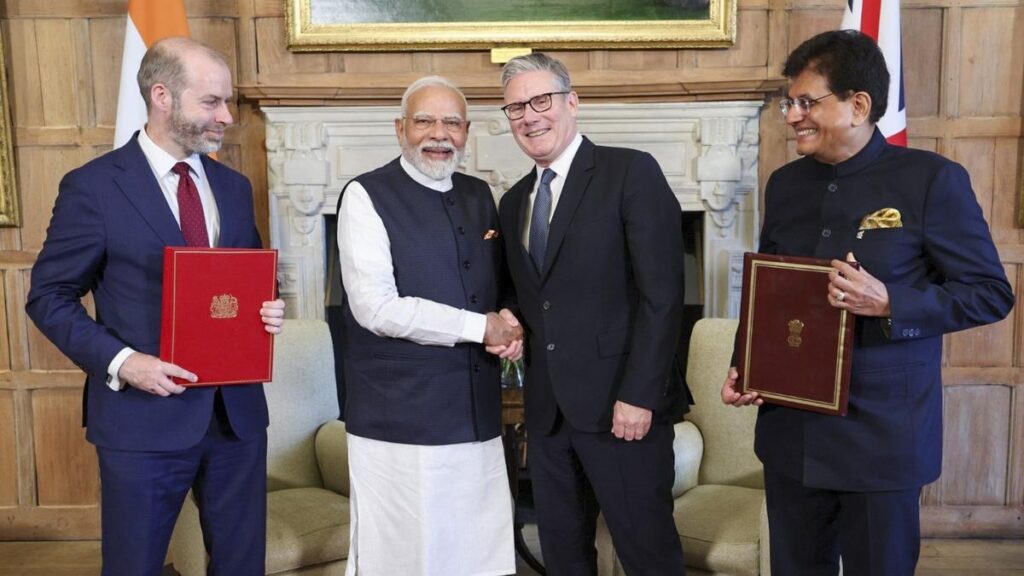
India and the United Kingdom recently signed a landmark Free Trade Agreement (FTA) during Prime Minister Narendra Modi’s visit to the UK in July 2025. This agreement represents a historic milestone in bilateral economic relations, expected to significantly boost trade, lower tariffs, and open new opportunities for businesses and consumers in both countries. It is India’s first major bilateral trade deal with a developed country in over a decade and the UK’s most significant trade pact since Brexit.
Overview of the India-UK Free Trade Agreement
The India-UK FTA aims to double bilateral trade from the current level of around USD 60 billion to USD 120 billion by 2030. The deal is designed to lower or eliminate tariffs on a wide range of goods and services, simplify regulations, and foster investment and innovation cooperation. Indian exports to the UK will benefit from duty-free access on 99% of tariff lines, covering almost all current exports. Likewise, India will reduce tariffs on 90% of UK products entering its market.
Key Features and Sectors Impacted
- Indian Exports: The agreement will facilitate better market access for Indian labor-intensive products such as textiles, leather, footwear, gems and jewellery, seafood, and engineering goods. Agricultural produce and processed food industries in India are also expected to gain new opportunities in the UK food processing sector.
- UK Exports: British products such as whisky, cars, medical devices, aerospace components, and clean energy technologies will have reduced tariffs and greater access to the Indian market. For instance, tariffs on Scotch whisky will be halved immediately and gradually lowered from 75% to 40% within a decade. Tariffs on electric vehicles entering India will also reduce from 110% to 10% over time.
- Social Security and Labor Mobility: The agreement includes provisions for social security cooperation, allowing Indian companies to send employees to the UK without double social security contributions, reducing business costs and fostering labor mobility.
- Investment and Innovation: The FTA strengthens investment flows and innovation partnerships in sectors such as defense, climate innovation, education, artificial intelligence, and semiconductor manufacturing.
Will Alcohol Become Cheaper in India?
Regarding the specific question of whether alcohol will become cheaper in India due to this FTA, the agreement does reduce tariffs on certain imported alcoholic beverages like British whisky, and on some vehicles and medical devices. However, the FTA primarily facilitates the reduction of tariffs on British products entering India, which could lead to more competitive pricing for UK whisky in Indian markets. For Indian consumers, this may mean better availability of British whisky at potentially lower prices, but this effect depends on how state-level taxes and local regulations on alcohol continue to be applied, given that alcohol pricing in India is heavily influenced by state excise policies as well as import tariffs.
At the same time, Indian domestically produced alcohol products may face new competition in both the UK and Indian markets, as Indian exports will be more competitive in the UK due to tariff reductions. This may not directly lower prices of locally produced alcohol in India but could stimulate the market competitively.
Broader Economic Benefits for India
The FTA is expected to:
- Strengthen India’s manufacturing and MSME sectors by providing greater access to a developed economy.
- Benefit farmers through improved export prospects for agricultural and processed food products.
- Create new employment opportunities in both countries by expanding trade and investment.
- Provide a model for India’s future trade negotiations with other developed economies, including the European Union.
Political and Diplomatic Dimensions
The deal was signed by Prime Ministers Narendra Modi and Keir Starmer, signaling a deepening strategic partnership. The UK sees this as a message of its openness for global business post-Brexit. Discussions also covered cooperation in defense, climate change, education, and issues related to security concerns such as the presence of Khalistani extremists in the UK.
Implementation and Future Outlook
The agreement must be ratified by the British Parliament, a process expected to take about a year before full implementation. Once enacted, the FTA is poised to be transformative in shaping the economic ties between India and the UK, providing a blueprint for shared prosperity and stronger bilateral ties.