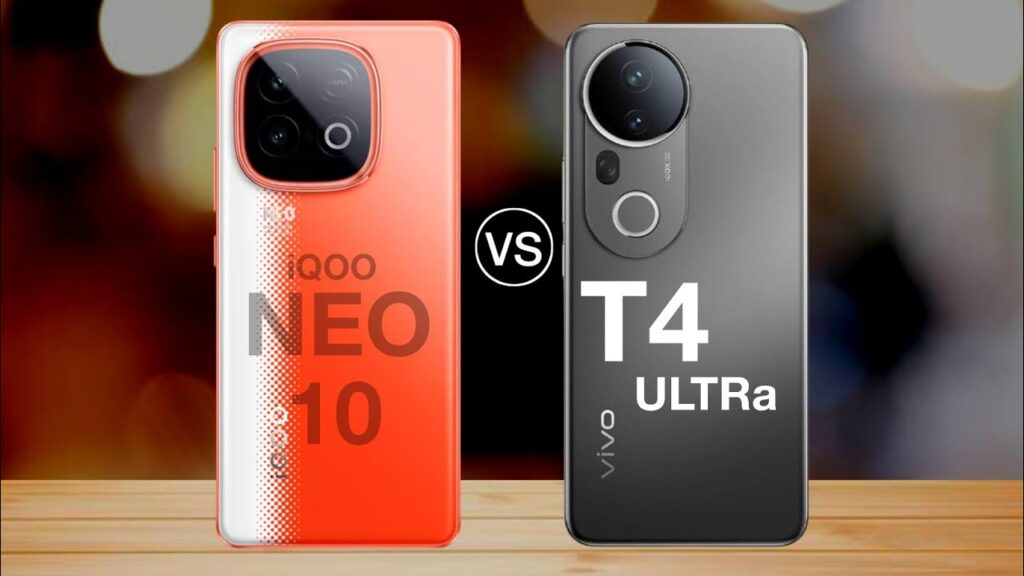
The smartphone market is abuzz with two compelling contenders: the Vivo T4 Ultra and the iQOO Neo 10. Both devices aim to deliver flagship-level experiences without the premium price tag. But which one truly stands out? This detailed comparison, drawing insights from a recent video review, delves into their performance, camera capabilities, battery life, and other crucial features to help you make an informed decision.
Performance: A Close Contest with a Gaming Edge
When it comes to raw power, both phones pack a punch. The iQOO Neo 10 boasts a Snapdragon 8S Gen 4 chipset, paired with LPDDR5X RAM and UFS 3.1/4.1 storage. In contrast, the Vivo T4 Ultra features a Dimensity 9300+ chipset with LPDDR5 RAM and UFS 3.1 storage across all variants .
Benchmarking scores, including AnTuTu and Geekbench, show a very close race, with Vivo performing similarly in single-core and multi-core tests . However, in demanding 3D Wild Life tests, the Vivo T4 Ultra, despite significant heating, achieved better scores . Vivo also edged out iQOO in video rendering and internal file copy-paste tests . For app loading, neither showed a consistent lead, with iQOO slightly faster for BGMI and Vivo for COD .
For serious gamers, the iQOO Neo 10 takes a clear lead, supporting 120 FPS in BGMI, whereas the Vivo T4 Ultra is capped at 90 FPS . While both maintained good FPS stability during a 1-hour BGMI test at 90 FPS , iQOO did show slightly higher temperature gain . Ultimately, for those prioritizing higher frame rates in gaming, iQOO is the superior choice .
Battery & Charging: iQOO’s Undeniable Dominance
This is where the iQOO Neo 10 truly shines. It comes with a blazing-fast 120W charger (Type-C to Type-C with PD charging support) and charges 10-12 minutes faster than the Vivo T4 Ultra .
Battery life is another clear win for iQOO, thanks to its larger 7000 mAh battery, which delivers an impressive 9-10 hours of screen-on time and can last 1.5 to 1.75 days with moderate use . The Vivo T4 Ultra, with its 5500 mAh battery, struggles with optimization, providing only 4-6.5 hours of screen-on time and often requiring a second charge within a day . iQOO also offers convenient bypass charging .
Thermal management is a significant concern for the Vivo T4 Ultra. In a 3-hour extreme test, Vivo’s battery drained 45% and its temperature soared to 48°C, while iQOO maintained better thermal control with only 39% drain . Vivo tends to warm up even during normal use, like scrolling through reels .
Design & Display: Aesthetics vs. Functionality
In terms of build, the iQOO Neo 10 features an all-plastic construction (frame and back), which might show signs of wear over time . The Vivo T4 Ultra, however, offers a more premium feel with a plastic frame and an appealing glass back, particularly in its grey matte finish .
Neither phone boasts a strong IP rating, making them vulnerable to water damage . Notably, the Vivo T4 Ultra has downgraded its IP rating to IP64 from the T3 Ultra’s IP68 . For haptics, iQOO provides a stronger vibration motor compared to Vivo’s more basic one .
The display experience is largely excellent on both. iQOO features a flat display, while Vivo opts for a quad-curved display . Both have minimal bezels, with Vivo’s appearing more symmetrical . Both offer 1.5K resolution, HDR10+ certification, and vibrant AMOLED panels . The iQOO Neo 10 pulls ahead with higher outdoor HBM brightness (2000 nits) and a higher PWM dimming frequency, which is better for eye comfort in low-light conditions . While iQOO promotes a 144Hz display, it typically runs at 120Hz, with 144Hz only accessible in select games .
Camera: Vivo’s Periscope Advantage
Both phones feature a 50MP main sensor with OIS, with iQOO using Sony IMX 882 and Vivo using Sony IMX 921 . Both also have an 8MP ultrawide sensor, offering decent results and supporting 1080p 30fps video recording .
However, the Vivo T4 Ultra gains a significant edge with its dedicated 50MP periscope telephoto lens with OIS, a feature absent in the iQOO Neo 10 . Both come with 32MP front cameras .
In terms of image processing, Vivo is known for its vibrant, boosted colors that look good in both low light and daylight, though it can sometimes oversaturate greens and reds . iQOO, on the other hand, tends to whiten human skin tones . While iQOO sometimes offers better details when zooming into 1x images, it can appear over-sharpened .
Vivo’s 3X periscope lens offers versatile focal length options (85mm and 100mm) for portrait mode, delivering “next-level” portrait images with rich, saturated details . iQOO relies on digital zoom for its portrait options . Vivo also boasts up to 100X zoom, with usable results at 20X-30X, and includes a “Tele Macro” feature for close-up shots at 10X-20X zoom .
For selfies, Vivo’s front camera is generally more consistent and satisfying, though slightly warm . iQOO’s front camera can over-sharpen and inconsistently alter skin tones in different lighting .
In video recording, both support up to 4K 60fps with the main camera . Vivo’s 4K 60fps footage is less stable when walking, but its 4K 30fps quality is superior with fewer jerks and better colors . Crucially, Vivo supports 1080p 30fps portrait videos using both the main and 3X telephoto cameras, a feature missing in iQOO . Front camera video at 4K 60fps lacks stability on both, but 4K 30fps offers more stable footage . The reviewer emphasizes Vivo’s periscope camera as a significant differentiator.
Other Features & Conclusion
Both phones offer excellent network connectivity, good Wi-Fi/5G coverage, and clear call quality. iQOO has Wi-Fi 7, while both have NFC. Only iQOO includes an IR blaster.
Both run Funtouch OS 15 based on Android 15, sharing similar UI and features, though the current UI isn’t considered outstanding compared to other brands. Both will receive three major OS updates and four years of security updates. While both come with bloatware, it can be uninstalled or disabled . Both also support discreet call recording and offer common AI features like Circle to Search, AI Eraser, AI Image Expander, AI Cutout, and AI Photo Enhance . A notable difference is iQOO’s security screen, which sometimes displays “vulgar” app recommendations when installing from the Play Store, a practice Vivo avoids.
A significant drawback for the Vivo T4 Ultra is its poor RAM management, often closing background apps. In terms of pricing, iQOO is generally more affordable across all variants .
In summary:
- Choose Vivo T4 Ultra if: You prioritize a more attractive design, a slimmer and lighter form factor, and a versatile 3X periscope camera for next-level photography. Be prepared to compromise on heating issues and potentially poor RAM management.
- Choose iQOO Neo 10 if: You are a serious gamer looking for higher FPS, demand significantly better battery life, and prefer higher outdoor display brightness. Be aware of its “okay” camera performance compared to Vivo and potentially intrusive app recommendations.
The ultimate decision hinges on your personal priorities: whether performance and battery life (iQOO) or camera capabilities (Vivo) are more crucial to your smartphone experience .