Introduction
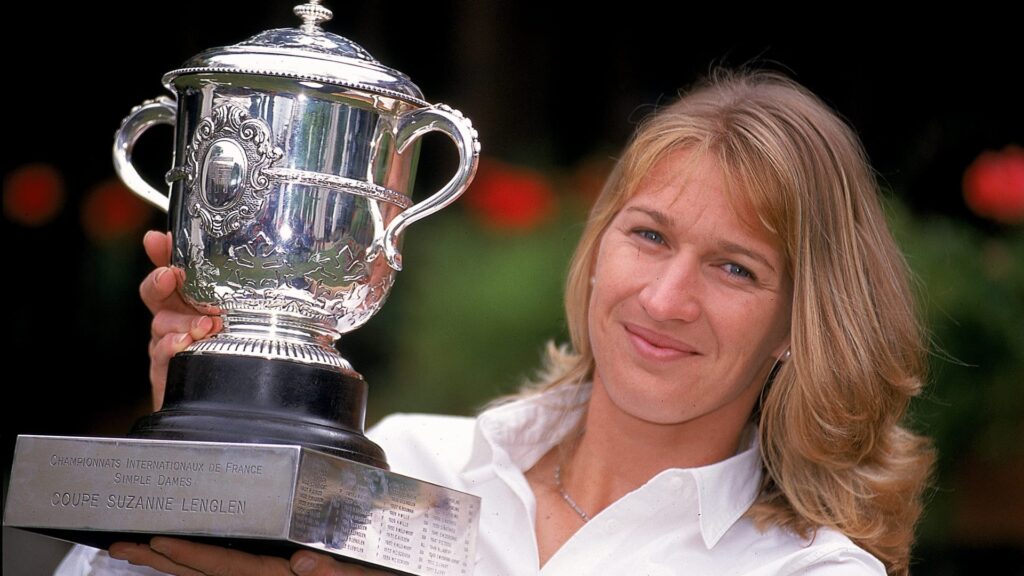
Steffi Graf’s legacy is the story of a prodigy who transcended tennis with unmatched determination, skill, and class. Holder of a record 22 Grand Slam singles titles and the only player ever to win the Golden Slam, Graf’s reign in the late 1980s and 1990s set standards for athletic excellence. Her powerful forehand and athletic build revolutionized women’s tennis and left an imprint that endures in the sport’s history.
Early Life and Family
Childhood in Germany
Stefanie Maria Graf was born on June 14, 1969, in Mannheim, West Germany. Her father, Peter Graf, was an aspiring tennis coach, and her mother, Heidi Graf, worked as a homemaker. At just three years old, Steffi started swinging a tennis racket under her father’s guidance, showing early promise in her athletic pursuits.
The Graf family’s commitment to Steffi’s training defined her early years. Peter’s ambition and structured regimen provided the foundation for her professional approach, instilling discipline and focus from a young age.
Early Training and Development
Steffi’s earliest competitions came in local tournaments at age five. As she advanced, her rigorous daily routines included hours of tennis drills, running, and coordination exercises. By age 13, she played in the main draw of the French Open, marking her entry into elite tennis.
Entering the Tennis Arena
Teenage Sensation
Steffi’s main breakthrough came in the mid-1980s. She emerged as a prodigy in Germany, joining the professional circuit and regularly challenging tennis legends like Chris Evert and Martina Navratilova. In 1987, she won her first Grand Slam title at the French Open, ending years of dominance by Evert and Navratilova and signaling a new era in women’s tennis.
Early Successes and Rankings
Graf’s rapid improvement saw her climb the global rankings quickly. Her athleticism, relentless baseline game, and formidable forehand allowed her to defeat older, more experienced competitors by age 16.
Career Highlights: The Golden Slam
The Historic 1988 Season
In 1988, Steffi Graf achieved the sport’s most elusive feat: the Golden Slam. She won all four major Grand Slam events—the Australian Open, French Open, Wimbledon, and the US Open—plus the Olympic gold medal, becoming the only player to do this in a single year. At just 19, Graf’s dominance was absolute; she played 28 Grand Slam singles matches that year, winning every major available on every surface.
Career Super Slam
Graf didn’t just stop at the Golden Slam. By 1999, she had completed a Career Super Slam—all majors, the Olympic gold, Fed Cup, and WTA Tour Championships. No female player has replicated this achievement to date.
Playing Style and Influence
Forehand and All-Court Game
Graf’s inside-out forehand remains one of the strongest shots ever known in women’s tennis—powerful, precise, and intimidating to even the toughest opponents. She combined swift footwork with an aggressive approach, allowing for versatile play on grass, clay, and hard courts.
Athleticism and Evolution
Graf’s fitness revolutionized female athletic standards in tennis. Her commitment to conditioning enabled extraordinary mobility and stamina, often outlasting rivals physically and mentally through long, high-stakes matches. Technically, she relied less on a traditional double-handed backhand and more on consistent slice and quick transitions.
Rivalries and Major Finals
Competing Against Legends
Steffi Graf’s main rivals included Monica Seles, Martina Navratilova, and Arantxa Sánchez Vicario. Graf’s matches with Navratilova, especially the landmark Wimbledon final in 1988, changed sporting narratives and marked her emergence as the new dominant force.
Monica Seles Rivalry
Monica Seles overtook Graf for a brief time in the early 1990s. Their rivalry was cut short by Seles’s tragic stabbing in 1993, after which Graf reclaimed her No. 1 spot and reestablished herself at the top of women’s tennis.
Grand Slam Records and Achievements
| Tournament | Titles | Years Won | Finals | Win-Loss Major | Highlights |
|---|---|---|---|---|---|
| Australian Open | 4 | 1988, 1989, 1990, 1994 | 7 | 47-6 | Golden Slam year |
| French Open | 6 | 1987, 1988, 1993, 1995, 1996, 1999 | 9 | 87-10 | Double bagel final |
| Wimbledon | 7 | 1988, 1989, 1991, 1992, 1993, 1995, 1996 | 9 | 75-8 | Beat Navratilova 1988 |
| US Open | 5 | 1988, 1989, 1993, 1995, 1996 | 8 | 73-10 | All surfaces |
Graf is the only player (male or female) to win each Grand Slam at least four times.
Records and Statistical Milestones
- 22 Grand Slam singles titles—the highest in the Open Era until surpassed by Serena Williams
- Held the WTA No. 1 ranking for a record 377 weeks—an unbeaten duration
- 186 consecutive weeks as No. 1—equaled only by Serena Williams
- Won 13 consecutive Grand Slam finals between 1987 and 1990
- 902 career singles wins out of 1017 matches
- Highest Grand Slam win percentage—89.7%
- Wimbledon win percentage—91.35%
- 107 career singles titles
- Over $21.8 million career prize money
Injuries, Retirement, and Legacy
End of an Era
Despite injuries, Graf remained at the top tier well into the late 1990s. She won her last Grand Slam at the French Open and almost claimed a final Wimbledon title in 1999 at age 30. Accepting the toll of recurring injuries, she retired that August, ranked world No. 3.
Influence and Post-Retirement Work
Graf’s post-tennis years include founding the Children for Tomorrow charitable foundation and collaborating with the Andre Agassi Foundation for Education, supporting children’s recovery from trauma and access to education. She now serves as a global sports ambassador, maintaining her reputation for professionalism, humility, and philanthropy.
Personal Life
Family
Steffi Graf married Andre Agassi, a fellow tennis legend and Career Super Slam winner, in 2001. They have two children. Graf’s private life is marked by dignity and commitment to family values, rarely courting media speculation despite global fame.
Honors, Awards, and Social Impact
Major Professional Honors
- Inducted into the International Tennis Hall of Fame (2004)
- ITF World Champion (seven times)
- WTA Player of the Year (eight times)
- German Sportswoman of the Year (multiple)
- Olympic Gold Medalist (1988)
Philanthropy and Social Activities
Steffi Graf’s foundation, Children for Tomorrow, aids young people impacted by war and trauma, reflecting her commitment to using sports as a vehicle for positive change.
Style, Attitude, and Influence
Steffi Graf was not just defined by her numbers; her mental resilience, grace on and off the court, and pioneering spirit elevated athlete standards for generations. She inspired aspiring tennis players worldwide, showing how athleticism, discipline, and integrity can break boundaries and create lasting legacies.
Contributions to Tennis and Women’s Sport
Graf’s dominance coincided with an era of transformation in women’s tennis—her powerful forehand and athletic prowess changed how competitors trained and how audiences perceived female athletes. She directly inspired future generations, from Serena Williams to Maria Sharapova, whose careers reflect Graf’s standards of excellence and global appeal.