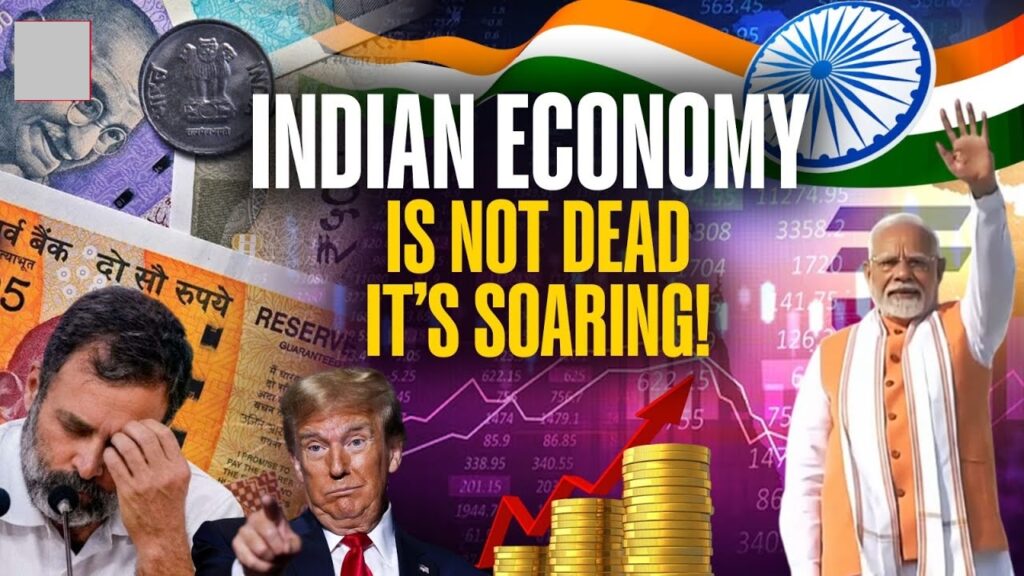
The Indian economy has been thrust into global debate following US President Donald Trump’s controversial statement labeling India and Russia as “dead economies” and announcing steep tariffs on Indian imports. This blog dives into the facts, separating rhetoric from reality by exploring India’s actual economic performance, the significance of US-India trade, the likely impacts of these tariffs, and how India might navigate the complexities ahead—all while drawing upon expert insights and the latest d
1. Introduction: Trump’s Claims and What’s at Stake
US President Donald Trump’s declaration that India is a “dead economy”—coupled with the imposition of a 25% tariff on Indian goods effective August1, 2025—sent shockwaves through the policy and investing community. The reasons given range from India’s “high tariffs” to what Trump describes as an unfavorable trading relationship and India’s closer ties with Russia.
But does this rhetoric reflect ground realities? To answer that, let’s dive into both the numbers and the broader context.
2. Is the Indian Economy “Dead”?
India’s GDP Growth in 2025–2026
Contrary to claims of economic decline, independent global institutions project robust growth for India. The International Monetary Fund (IMF) recently upgraded India’s GDP growth forecast to 6.4% for both 2025 and 2026, up from its previous estimate of 6.2%. The underlying factors for this optimism are a friendlier external environment and record-low inflation.
“A country with potential growth of 6.5–7%, which will soon be the 3rd largest economy in the world, driven by a young workforce… is far from a dead economy.”
— Dhiraj Nim, Economist, ANZ Research
According to the Reserve Bank of India, India’s GDP already exceeds $4.1trillion, and the IMF projects it will cross $6.8trillion by 2030.
Economic Fundamentals and Global Perceptions
Key indicators reinforce India’s economic vitality:
- Inflation: Core inflation has dropped to 2.1%, within the Reserve Bank’s target.
- Interest Rates: Entering a rate cut cycle, making credit more affordable and boosting growth.
- Debt-to-GDP: At 81.6%, which, while high, is significantly lower than the US’s 130%+.
- Unemployment: Remaining stable, with improvement potential.
- Fiscal Deficit: Reduced from 5.87% to 4.8%, showing improved fiscal discipline.
- Manufacturing PMI: At 59.1, indicating strong expansion.
And, notably, recent years have seen India leap from being in the “fragile five” to occupying the world’s top-five economies. Achievements include a surge in digital financial transactions via UPI (over 640million daily), and a sharp rise in the population with bank access (from 35% to 89% between 2011 and now).
Critical Voices and Room for Improvement
Not everyone is satisfied. Critics point to India’s low per capita GDP ($3,000), relatively slow growth for a developing country, high luxury taxes, and top global status in millionaire migration and remittance inflows as symptoms of deeper challenges. These highlight the need for more investment in health, education, and innovation.
Still, even these criticisms don’t justify the hyperbolic “dead economy” label. Major global analysts—and even many critics—acknowledge India’s strengths and its potential for rapid, inclusive growth.
3. US-India Trade Relations: How Significant Is America for India?
Top Export Destinations and Trade Surpluses
The US remains India’s most important export market, accounting for nearly a fifth of total shipments. India runs a trade surplus both in goods and in services with the US, meaning it sells more to the US than it buys.
For nine key product categories—engineering, electronics, software, textiles, pharma, chemicals, gems, agriculture, marine, and leather—the US is the top destination for Indian exports. Individual sectors such as engineering alone send over $18billion worth of goods to America every year.
Tariffs, Sectors, and Negotiation Tensions
Trump’s core complaint is India’s high tariffs on US exports, notably:
- Dairy: 30–60%
- Farm products: 30–50%
- Automobiles (including EVs): 70–100%
- Wines: 100–150%
While these protect key domestic sectors, they are a continuous source of US frustration and negotiation roadblocks.
4. The 25% Tariff: Decoding Impact and Strategic Implications
Immediate Effects on Growth and Exports
Experts estimate the new US tariffs may reduce India’s GDP growth rate by 0.2–0.4 percentage points if maintained throughout 2025–2026. The RBI had forecast 6.5% growth for 2025–26, and most analysts now expect 6.1–6.3%.
The impact is considered manageable for the broader economy, but individual export sectors and firms deeply reliant on US access may see sharper short-term pain.
Sectoral Breakdown of Tariff Exposure
- Textiles: A major concern, particularly as the US also considers lowering Bangladesh’s textile tariffs, threatening Indian exporters’ edge.
- Engineering goods and software: Less sensitive to tariffs, but still vital.
- Services and specialty goods: Ongoing trade surplus with the US cushions some of the blow.
Investor Sentiment and Currency Effects
Tariff shocks can cause stock market volatility, a pause in foreign portfolio inflows, and potential depreciation pressure on the rupee. Reduced exports increase the trade deficit, risking inflation if imports become costlier.
However, medium-term prospects remain stable because India’s fundamentals are strong, and the current policy environment helps attract alternative investments (including those pivoting away from China).
5. Indian Resilience and the Road Ahead
Structural Strengths and Opportunity Amidst Turbulence
India’s ability to withstand global shocks stems from:
- Robust domestic demand, especially in rural markets.
- A young and growing workforce ready to drive consumption-led growth.
- Successful digital public goods (UPI, Aadhaar) making business easier and more inclusive.
- Reform momentum supporting innovation, manufacturing, and financial inclusion.
While the US remains crucial, India is actively expanding partnerships in Asia, Africa, Europe, and Latin America, diversifying both markets and sources of capital.
Digital Transformations and Global Standing
From daily UPI payments to the rise in bank account penetration and mobile-first commerce, India’s digital revolution is a global case study in scale and speed. The IMF also describes India as a “bright spot” of global growth.
6. Conclusions: Why the “Dead Economy” Tag Misses the Mark
Donald Trump’s statements do not reflect the underlying dynamism of India’s economy, nor the consensus of global economic experts. While the new 25% tariff adds short-term challenges, India’s economic engine is far from stalling—let alone dead.
Challenges remain: export competitiveness, per capita GDP, and social spending are areas for urgent improvement. But the facts show an economy on the move, continually adapting, and positioned as a global growth leader through the rest of the decade.
“Trump’s tweet is better seen as negotiation posturing rather than economic analysis. India’s structural strengths ensure resilience—even amidst global trade wars.”
— Economic Commentator