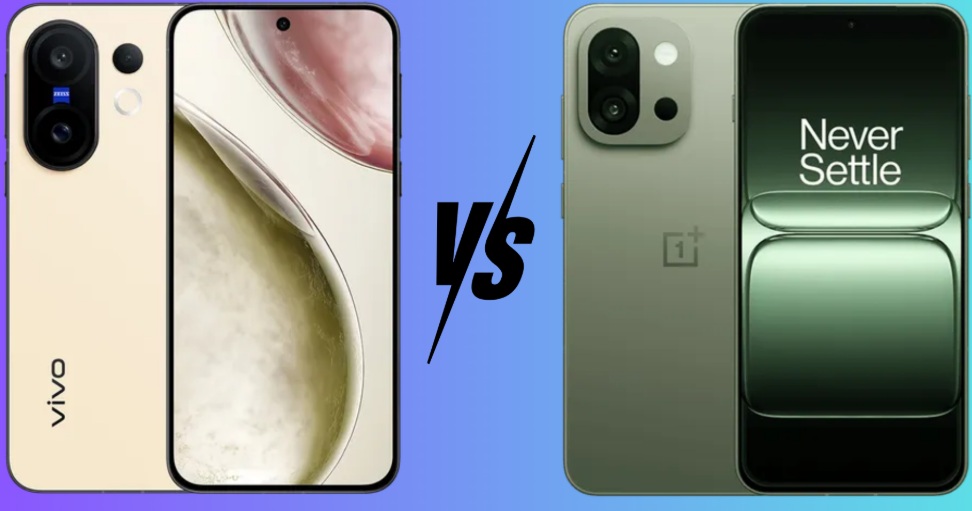
Choosing between the vivo X200 FE and the OnePlus 13s can be quite confusing for buyers in the mid-premium smartphone segment. Both offer compelling features, cutting-edge specs, and premium designs. In this comprehensive comparison, we break down every major aspect of these two devices to help you make an informed choice.
Display: Brightness, Smoothness, and Experience
Both phones sport nearly identical AMOLED displays with very close sizes—vivo X200 FE packs a 6.31-inch panel, while the OnePlus 13s offers 6.32 inches. Both screens have a high resolution with a pixel density around 1.5K and support a 1120 Hz touch sampling rate. They sport an LTPO display, which means the refresh rate can adaptively shift between 1 Hz to 120 Hz, enhancing battery life without compromising experience.
In terms of smoothness, both phones perform admirably well. The OnePlus UI slightly edges out vivo’s Funtouch OS in daily smoothness, with less jitter during faster gestures. Both phones have minimal vibration and a small punch-hole front camera. The OnePlus screen retains HDR content balance better on brightness, while vivo tends to brighten HDR content more aggressively, making it a matter of personal preference.
Vivo leads in peak brightness with an 1800 nits high-brightness mode and even claims a 5000-nit peak, whereas OnePlus maxes at 1600 nits. However, real-world testing showed both phones performed very similarly outdoors.
OnePlus supports Dolby Vision Special Audio and Vivo offers HDR special audio on Netflix. Both provide full HD streaming on Prime Video at 120Hz, letting users switch between full HD and 1.5K resolution to adjust battery usage.
Software and User Experience
The vivo X200 FE runs Funtouch OS 15 based on Android 15, offering four years of updates. It includes some bloatware like V Store ads and lock screen posters, which some users may find intrusive. The security patch is current as of July 1, 2025.
The OnePlus 13s runs OxygenOS 15 on Android 15, which also guarantees four years of updates. OxygenOS is cleaner and feels more optimized, leading to smoother overall performance compared to Funtouch OS. While it includes some pre-installed apps and a magazine lock screen option (turned off by default), it provides a more stock-like feel preferred by many.
Overall, the video reviewer preferred the OnePlus’s software experience for its optimization and smoother UI response.
Battery and Charging: Capacity Vs Optimization
The vivo X200 FE comes with a larger 6500 mAh battery, offering 90W fast charging included in the box. In contrast, the OnePlus 13s has a smaller 5850 mAh battery with 80W fast charging.
Charging times are close, with vivo reaching 50% in about 35 minutes and OnePlus doing the same in 25 minutes. From zero to full, vivo takes approximately 1 hour 2 minutes, while OnePlus charges fully in about 59 minutes.
Despite the larger battery, vivo’s battery drain is more pronounced. In a continuous 4K YouTube video playback test at full brightness, vivo’s battery dropped 39% over 10.5 hours, while OnePlus dropped 34%. Under heavy daily usage including gaming, browsing, and video recording, vivo ran out of battery significantly earlier than OnePlus, indicating poorer power optimization in vivo’s Dimensity 9300+ chipset.
The OnePlus 13s outperforms vivo in battery endurance by roughly 2 hours in real-life extensive use, showing excellent chipset optimization despite smaller battery size.
Performance: Chipsets and Gaming
vivo X200 FE uses the MediaTek Dimensity 9300+ chipset, while OnePlus 13s runs Qualcomm’s more powerful Snapdragon 8 Gen 2 (3nm). Benchmarks clearly show OnePlus’s Snapdragon outperforms vivo’s Dimensity with a higher score (~2.4 million vs 1.7-1.8 million in Antutu).
Both phones get hot under stress testing, with temperatures around 45-49°C. Snapdragon 8 Gen 2 is known for running hot as well but handles longer gaming sessions better.
In day-to-day gaming, OnePlus provides smoother frame rates (up to 120fps in BGMI) and slightly lower temperatures compared to vivo. In demanding titles like Genshin Impact, both maintain 50-60fps, but vivo shows more heat buildup. For heavy gamers, OnePlus is the preferred choice.
RAM, Storage, and Multitasking
Both phones come with LPDDR5X RAM, but vivo includes UFS 3.1 storage, while OnePlus upgrades to the faster UFS 4.0 storage standard. UFS 4 offers better read/write performance and is future-proof.
In multitasking tests, vivo held background apps more steadily without reloading, whereas OnePlus reloaded some apps frequently, suggesting better memory management on vivo’s part. However, the speed advantage still goes to OnePlus due to faster storage and chipset efficiency.
Camera: Who Wins the Imaging Battle?
This section strongly favors vivo X200 FE as a camera-centric phone. Both have a 50MP primary sensor (vivo uses Sony IMX 921, OnePlus uses Sony LYT 700). Vivo also adds an 8MP ultra-wide and a 50MP periscope telephoto lens supporting 100x zoom. The OnePlus 13s includes a 50MP telephoto sensor but lacks an ultra-wide camera, limiting versatility.
Photo and video quality testing across 16 scenarios show vivo dominating especially in portrait, zoom, and night photography. Vivo won 12 out of 16 criteria points versus OnePlus’s 6 points.
Vivo produces exceptionally sharp, well-balanced photos with better night mode performance. OnePlus holds up decently in daytime photos but falls behind in low-light conditions.
For video shooting, both can record 4K@60fps, with vivo showing marginal improvements in stabilization and detail.
Network, Connectivity, and Build Quality
Both phones support multiple 5G bands, Wi-Fi 7, NFC, and Bluetooth (OnePlus 6, vivo 5.4). Connectivity tests with Airtel and Jio SIMs showed stable and fast speeds on both.
Design-wise, both sport premium glass backs and aluminum frames. Vivo measures 8mm thickness, weighing 192g; OnePlus is slightly thinner at 8.2mm and marginally lighter at 186g, providing a slightly better hand feel.
IP rating favors vivo with IP68 water and dust resistance, while OnePlus has IP65 splash resistance.
Audio quality is similar with dual speakers, dual mics, and stereo sound. Haptics are better on OnePlus, providing a more tactile and refined vibration experience.
Conclusion: Which One Should You Buy?
The vivo X200 FE and OnePlus 13s both shine in different areas, making the choice based on user priorities:
- Choose vivo X200 FE if:
- You prioritize camera performance, especially night and zoom photography
- You want a larger battery and peak brightness for media consumption
- You like a balanced overall performance with better background app retention
- You want higher water and dust resistance (IP68)
- Choose OnePlus 13s if:
- You want superior performance with Snapdragon 8 Gen 2 chipset
- You demand better software experience with a slick, optimized UI
- Battery endurance and fast charging speed are your top concern
- Gaming at high FPS with better thermal management matters
- You prefer faster UFS 4.0 storage and better haptics
Both phones come at very similar prices around ₹54,999. The decision ultimately rests on whether you prioritize camera-centric features with larger battery or faster and smoother performance with better battery optimization.