Introduction and Overview
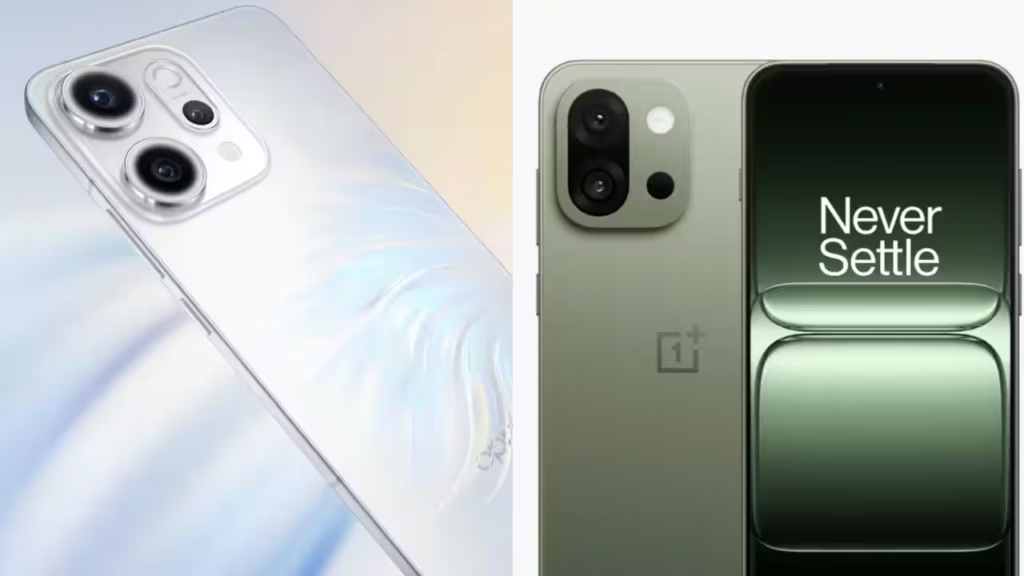
A detailed comparison between the OnePlus 13s and OPPO Reno 14 Pro, highlighting that both phones are premium devices with no compromise in box contents. Each phone offers a charger and a back cover in the box, which is considered a plus. The hosts mention that the comparison is unbiased and free from brand pressure, aiming to provide an honest perspective with pros and cons of both devices.
Design and Build Quality
Both phones have a premium look and feel, featuring glass backs and aluminum frames. Despite the OPPO Reno 14 Pro being larger in size, it has a slimmer thickness than the OnePlus 13s, which is more compact. An important point mentioned is the IP rating: the OPPO device offers superior water and dust resistance with an IP68 + IP69 rating, making it more durable against water damage than the OnePlus 13s, which only has an IP65 rating. Both phones support dual SIM and eSIM, but neither supports microSD card expansion.
Display Characteristics
- The OPPO Reno 14 Pro sports a larger display.
- Both phones have 1.5K resolution flat AMOLED panels with 120Hz refresh rates and support Aqua Touch technologies allowing smooth use even with wet hands.
- Both phone displays include PWM dimming to reduce eye strain at low brightness.
- The OnePlus 13s has an edge with its Crystal Shield glass protection versus OPPO’s Gorilla Glass 7i.
- The OnePlus 13s also delivers higher outdoor brightness, enhancing usability in direct sunlight.
- Additionally, the OnePlus display features LTPO technology that can vary refresh rate between 1Hz and 120Hz to conserve battery life.
Sound and Haptics
Contrary to expectations that the larger OPPO phone would have better sound quality with stronger bass, the OnePlus 13s surprisingly delivered richer and better bass with overall improved sound quality. Both phones feature dual speakers and precise haptic motors, contributing to an overall satisfying tactile experience.
Performance Comparison
A major divergence is in the chipset and performance:
- OnePlus 13s is powered by the flagship Qualcomm Snapdragon 8 Elite chipset, offering top-tier performance comparable to a “horse in a race.”
- OPPO Reno 14 Pro uses a mid-range MediaTek Dimensity 8450 chipset, which, despite good capabilities, is considered significantly inferior to the Snapdragon 8 Elite in raw power.
- Storage type and speed are also better on OnePlus, although both have similar RAM.
In benchmarks and daily usage, the OnePlus 13s runs smoother without UI jitters, while OPPO shows occasional stutters, though nothing severely impacting basic multitasking.
Battery Life and Heat Management
A thorough 3-hour testing involving multiple activities was conducted:
- Activities included one hour of WhatsApp video calling on 5G outdoors in hot, humid weather; one hour of 4K 60fps video recording; 30 minutes of reel watching; and 30 minutes of Netflix series downloading.
- Despite expectations that the larger OPPO’s 6200 mAh battery would outperform, the OnePlus’s 5850 mAh battery consistently provided longer screen-on-time and standby time.
- OnePlus benefits from its smaller display, LTPO display tech, and more power-efficient Snapdragon chipset.
- OPPO showed comparatively higher battery drain and better download speeds.
- Heating was notably higher on the compact OnePlus, with temperatures exceeding 50°C during video recording, attributed to the more compact form factor concentrating heat.
- OPPO remained cooler but consumed more battery.
Gaming Experience
In PUBG Mobile/BGMI gaming tests:
- OPPO Reno 14 Pro is limited to 60fps unlocked.
- OnePlus 13s supports 90fps gaming and achieves stable framerates at this higher setting.
- Both phones handled 60fps gaming smoothly, but higher frame rate gaming is a distinctive advantage of the OnePlus 13s, providing smoother gameplay.
Camera Comparison
While the video highlights camera testing, the detailed camera comparison results are summarized as follows:
- OPPO Reno 14 Pro is generally noted for having a strong camera setup relative to price.
- OnePlus 13s camera performance is good but slightly below OPPO in some scenarios.
- Both phones shoot 4K video at 60fps and handle HDR content well.
- OnePlus edges Netflix streaming by supporting Dolby Vision, delivering a superior picture quality over OPPO’s HDR10 support.
- Front camera and optical under-display fingerprint scanners perform reliably on both devices.
Software and UI
Both phones provide refined user interfaces with advanced haptic feedback integration. However, the OnePlus 13s offers smoother UI transitions and fewer stutters compared to the OPPO Reno 14 Pro, where occasional UI jitters were observed during multitasking. The comparison suggests smoother and more consistent day-to-day usage on OnePlus 13s.
Price and Value
- Both phones start from a similar price point around ₹45,000 without offers, with 12GB RAM and 256GB storage.
- Considering performance, display, battery life, and gaming, OnePlus 13s offers better value for power users.
- OPPO Reno 14 Pro appeals to users prioritizing camera and slightly better durability with superior waterproofing.
Final Recommendation
We concludes that the choice depends on user priorities:
- Choose OnePlus 13s if performance, gaming, battery efficiency, and brighter display matter the most.
- Choose OPPO Reno 14 Pro if you want a larger, slimmer display, better camera out of the box, and more robust water resistance at almost the same budget.
The comparison is balanced, helping buyers make informed decisions without brand bias